For several decades, digital transformation has largely been defined by the adoption of software platforms. Organizations implemented systems of work like Salesforce, Workday, and ServiceNow and often described these implementations as new capabilities.
But this language hides an important misunderstanding.
A platform is not a capability by itself. It is part of the capability. An enabler.
A capability is the organization’s ability to consistently achieve a desired outcome that helps it more effectively serve its customers, residents, or patients. That ability emerges from the coordinated operation of four elements:
- People: The humans and AI agents who perform the work and continuously improve how it is done.
- Policy: The rules, incentives, and governance structures that guide decisions and shape how work is performed.
- Process: The coordination and flow of activities that organize how work moves through the capability.
- Product: The tools and systems that enable work, capture signals, and record what happens.
Together, these elements enable an organization to deliver meaningful outcomes.
People
Consider what customer relationship management (CRM) actually requires. Many organizations say they have CRM capability because they use Salesforce. But building and sustaining strong customer relationships depends on listening, understanding customer needs, recognizing how those needs change, and acting on that understanding over time. It requires deep learning about the customer. In many organizations, the human focus shifted toward capturing data in predefined fields rather than learning through the conversations and interactions themselves. Valuable learning was lost because it did not fit neatly into the system’s structure.
In this way, the system of record became the center of work. The capability was underdeveloped as a result.
AI changes this dynamic directly. Agents can now interact with systems of record through APIs, handling much of the repetitive execution those platforms require: updating records, generating reports, routing requests, maintaining workflows. This creates a new operating layer where digital workers handle system execution.
That shift allows humans to refocus on the real purpose of the capability. Not every interaction requires the same kind of attention. Repeatable, structured interactions like support calls can be handled by agents backed by a strong knowledge base, freeing humans for the relationship-building and exploratory conversations where judgment and presence matter most. And even agent-handled interactions generate signal, expanding the organization’s ability to learn from its customer relationships at a scale no human team could manage alone.
The pairing of agents and humans is not a division of labor so much as a deliberate rebalancing: execution and routine interactions move to agents, judgment and relationship stay with people.
Policy
During the platform era, policy was often platform policy: the rules and governance baked into the software itself. Organizations adopted the vendor’s defaults rather than designing their own, making it an afterthought for transformation projects. What looked like operational governance was frequently just the system’s configuration.
AI forces policy to become genuinely explicit. Agents can only follow rules that are clearly articulated. Sure, some can come from platform documentation, but the vagueness and customized use that humans navigate intuitively has to be resolved and codified. In this sense, AI raises the standard for what policy actually means.
At the same time, the governance layer becomes significantly more consequential. Organizations are no longer governing human behavior alone. They are governing autonomous systems capable of acting at scale, across many interactions, continuously. The stakes of getting policy right are higher, and the margin for ambiguity is smaller.
Policy in the AI era therefore moves in two directions simultaneously: more precise in its rules, and more robust in its oversight. It becomes the mechanism through which humans maintain meaningful control over how the capability operates and evolves.
Process
Process during digital transformation was largely designed around the platform. Organizations adopted the workflow the software supported rather than the workflow that best served the capability. Sure there are exceptions, but business process maturity was, in many cases, constrained by platform process maturity.
When agents handle system execution, process can be genuinely reclaimed. Organizations are no longer constrained by what the software supports. They can design process around how value actually gets created, how teams work together, how signals flow back into the capability, and how the organization learns from what happens. The focus shifts to redesigning an antiquated operating model into a new operating system for the organization.
This is where continuous improvement becomes structurally possible rather than aspirational. A process designed for learning — one that captures not just activity but insight, not just output but signal — is the foundation of a capability that actually evolves. And the longer it operates, the deeper that understanding becomes — each cycle of learning informing the next.
Without learning, capabilities rarely improve. Process is the mechanism through which learning happens.
Product
Modern organizations generate enormous amounts of signal: customer conversations, support interactions, employee feedback, operational outcomes. Most of it remains fragmented across systems and documents. Context is often stripped out and lost. Conversations are compressed into short notes, insights are forced into structured fields, and transcripts accumulate without being interpreted collectively. The organization captures activity but does not generate learning.
This is partly a product architecture problem.
The platforms of the past decade were designed to be the center of work. In the AI era, they become infrastructure: an API layer that agents interact with directly. They remain valuable as systems of record, but they are no longer the organizing logic of the capability or home of daily work for people.
What rises above them is a new product entirely: an organizational operating system built for AI, sitting above the platforms and integrating with all of them. This is where governance lives, where agents operate under human oversight, and where the signals generated by real work are interpreted and connected. It becomes the singular layer through which anyone interacts with the organization — customer, employee, partner, or any other relationship.
This is the architectural signature of the AI-powered organization: a new layer in the stack, purpose-built for learning, sitting above the platforms that came before.
The Learning Organization
Digital transformation changed the tools organizations use. AI transformation changes what the organization fundamentally is.
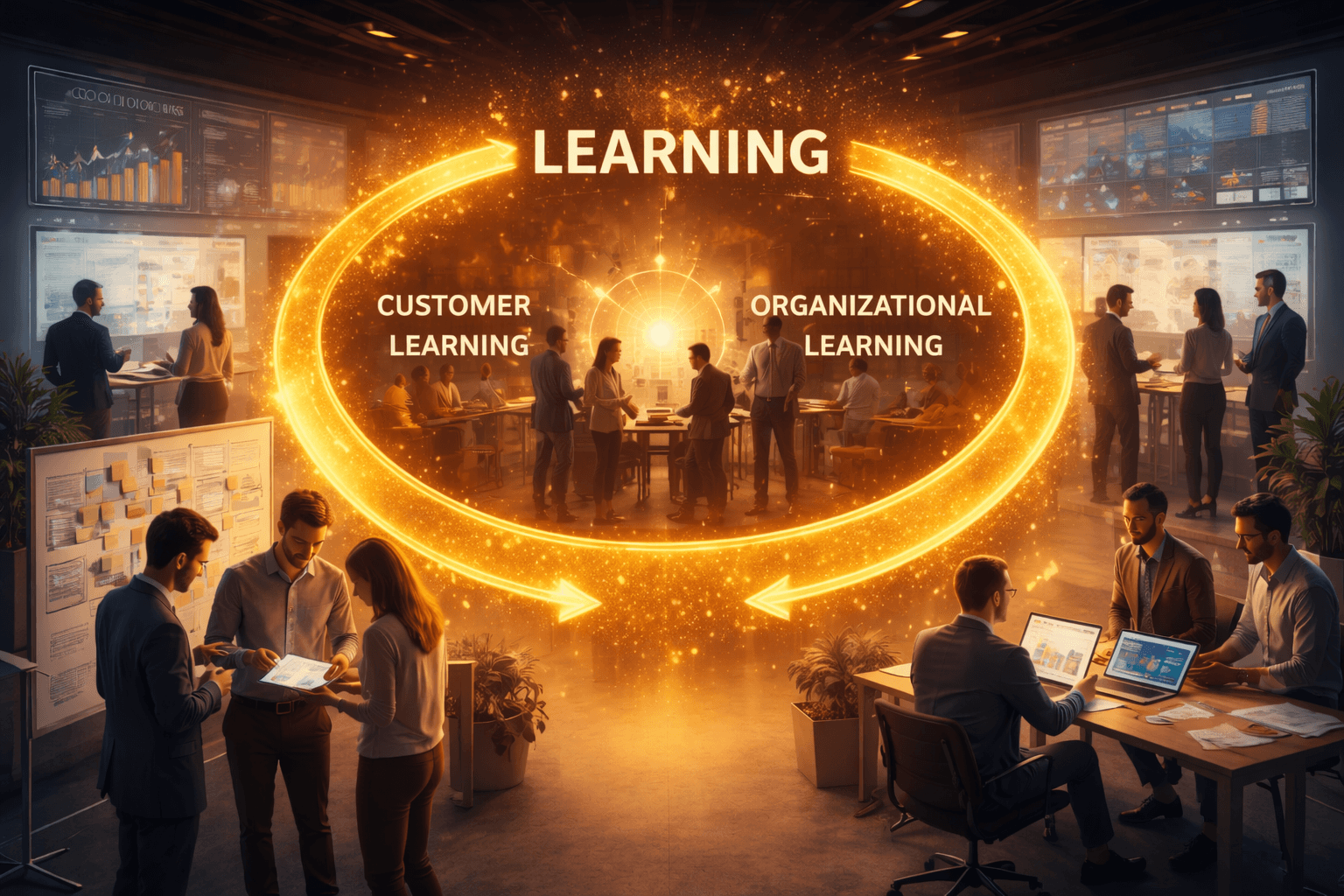
Peter Senge’s vision of the learning organization, which develops the capacity to learn, adapt, and improve continuously, was always the right destination. The constraint was human bandwidth. Learning from customers, synthesizing patterns across interactions, and feeding insight back into operations required more human attention and coordination than most organizations could sustain. Learning happened in pockets, inconsistently, and rarely at the speed customer needs required.
AI removes that constraint. Conversations can be fully captured and analyzed. Patterns can be synthesized across thousands of interactions simultaneously. Insight can flow back into the capability continuously rather than through annual planning cycles. The human intent Senge described can now be structurally supported rather than left to individual discipline.
Each of the four elements plays a role in shaping the capabilities that increase the organization’s potential. People bring judgment and relationship. Policy ensures autonomous systems operate within meaningful human governance. Process creates the conditions for learning and innovation rather than just execution. Product provides the infrastructure and the new operating layer that ties it all together.
The organizations that thrive will not simply be those that adopted AI most aggressively. They will be those that used it to build something that was not previously possible: an organization that learns continuously, improves deliberately, and remains genuinely aligned with the people it exists to serve.
Learning should not be viewed as one capability among many. It is the core capability that allows an organization to innovate and continuously improve everything else.